

Asia Pacific
Vision Correction in Asia-Pacific: What Consumers in China, Japan and South Korea Think
Findings from STAAR Surgical’s survey of 3,000 glasses and contact lens wearers in China, Japan and South Korea.
In STAAR Surgical’s Future of Refractive Surgery survey of 3,000 glasses and contact lens wearers in China, Japan and South Korea, 85% want to be free of glasses and contact lenses, but openness to laser does not come close to matching that demand. Across the region, 61% are not open to laser vision correction,1 and 79% of Chinese and South Korean respondents are interested in an alternative. More than half of respondents in Asia-Pacific would prefer a reversible procedure (63%).
| 3,000 | 61% | 79% | 63% |
| glasses and contact lens wearers in China, Japan and South Korea | are not open to laser vision correction1 | of Chinese and South Korean respondents are interested in an alternative to laser2 | would prefer a reversible procedure |
1 Sentiment split (Not open / Undecided / Open) is calculated as each category’s share of total selections in the multi-select question (“What do you think of Laser Vision Correction Surgery?”). 2Question was not fielded in Japan. Source: STAAR Consumer Survey, APAC Combined Summary (n=3,000).
THREE MARKETS · 3,000 VOICES
China · Japan · South Korea
Who took part in the Asia-Pacific survey?
STAAR Surgical surveyed 3,000 adults who wear glasses and/or contact lenses: 1,000 each in China, Japan and South Korea, in May 2026. 51% of respondents were female, and 73% were aged 21-45.
Source: STAAR Consumer Survey, APAC Combined Summary (n=3,000), fieldwork May 2026.
How do consumers in Asia-Pacific feel about laser eye surgery?
Most want to be free of glasses and contact lenses, but far fewer are open to laser. 85% of respondents in China, Japan and South Korea say that, in an ideal world, they would be free of glasses and contacts. Yet across the region, 61% are not open to laser vision correction, 20% are undecided and 19% are open.¹
Across APAC, Six in Ten Consumers Are Not Open to Laser
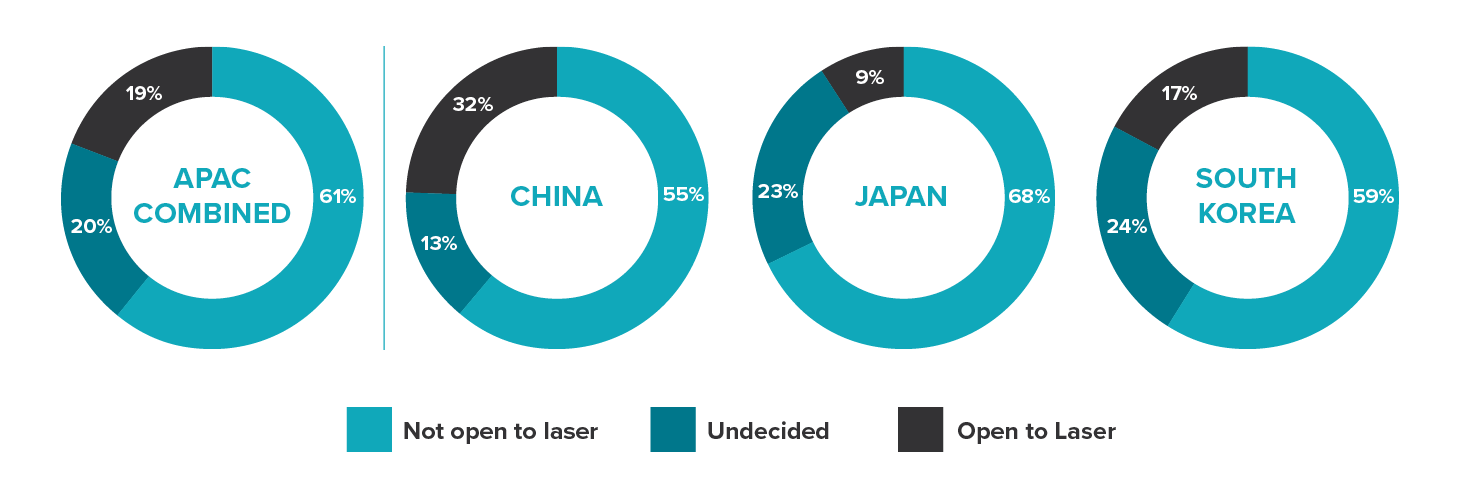
Across APAC, 61% are not open to laser, ranging from 55% in China to 68% in Japan.
Table: Across APAC, Six in Ten Consumers Are Not Open to Laser
| Market | Not open to laser | Undecided | Open to Laser |
| APAC Combined | 61% | 20% | 19% |
| China | 55% | 13% | 32% |
| Japan | 68% | 23% | 9% |
| South Korea | 59% | 24% | 17% |
1 Sentiment split (Not open / Undecided / Open) is calculated as each category’s share of total selections in the multi-select question (“What do you think of Laser Vision Correction Surgery?”). China, Japan, and South Korea used parallel APAC question sets with explicit Open / Not Open coding.
2 Age distribution differs materially by market (share aged 21–45: China 94%, South Korea 76%, Japan 50%); cross-market sentiment comparisons should be read with this in mind.
Source: STAAR Consumer Survey, APAC Combined Summary (n=3,000). Shares of total selections in the laser sentiment question.
What holds consumers in Asia-Pacific back from vision correction surgery?
Across Asia-Pacific, concerns about safety or potential complications are the top barrier (70%), with uncertainty about long-term outcomes and concern about pain or discomfort close behind (69% each). Safety leads in China (76%) and uncertainty about long-term outcomes in South Korea (72%), while in Japan, fear of the treatment and difficulty justifying the expense tie at the top (69% each). A lack of information about available options holds back 61% of respondents across the region.
Top Barriers to Refractive Surgery: Safety, Uncertainty, and Fear Outrank Cost
Asked to score what holds them back from a vision correction procedure, APAC respondents put safety, not cost, at the top.
Safety concerns lead across APAC (70%); in Japan, justifying the expense ties fear at 69%.
Table: Top Barriers to Refractive Surgery: Safety, Uncertainty, and Fear Outrank Cost
Percentages are respondents scoring the factor 4 or 5 on a 5-point scale (n=3,000):
| Barrier | APAC | China | S. Korea | Japan |
| Concerns about safety or potential complications | 70% | 76% | 71% | 64% |
| Uncertainty about long-term outcomes | 69% | 74% | 72% | 62% |
| Concern about pain or discomfort | 69% | 73% | 70% | 63% |
| Fear of undergoing the treatment or surgery | 68% | 66% | 70% | 69% |
| Lack of info about available options | 61% | 69% | 56% | 59% |
| Difficulty justifying the expense | 59% | 51% | 58% | 69% |
Source: STAAR Consumer Survey.
How open are consumers in Asia-Pacific to alternatives to laser correction, and how aware are they of ICL?
Across respondents in Asia-Pacific, interest in an alternative to laser is high: 90% in China and 69% in South Korea (the question was not fielded in Japan). More than half (63%) of respondents in the region would prefer a reversible procedure.
Just under half of respondents (45%) are aware of the implantable Collamer lens (ICL) unaided, including 49% in China, 46% in Japan and 41% in South Korea.
Openness to Alternatives
Among those asked in Asia-Pacific (China and South Korea for this survey), 79% of respondents are interested in an alternative to laser. Across the region (including China, Japan and South Korea), more than half would prefer a reversible procedure. Fewer than half (45%) are aware of ICL unaided.
Table: Openness to Alternatives
| Measure | APAC | China | S. Korea | Japan |
| Aware of ICL (unaided procedure awareness)1 | 45% | 49% | 41% | 46% |
| Would prefer a reversible procedure | 63% | 86% | 64% | 38% |
| Interested in an alternative to laser2 | 79% | 90% | 69% | n/a |
Source: STAAR Consumer Survey, APAC Combined Summary. 1 Multi-select 2 Question was not fielded in Japan; the APAC figure reflects China and South Korea (n=2,000).
How is the refractive surgery market changing in Asia-Pacific?
Asia-Pacific accounts for roughly half of global refractive procedure volume, and it is where the shift toward lens-based procedures is furthest along. Market Scope estimates that more ICL procedures were performed in China in 2024 than in all other countries combined. In Japan, phakic IOLs accounted for an estimated 64% of refractive procedures in 2025, and South Korea has the world’s highest per-capita rate of phakic IOL procedures.
Sources: Market Scope, 2025 Refractive Surgery Market Report.
 |  |  |  |
| China: Country Findings | Japan: Country Findings | South Korea: Country Findings | Global Findings: Key Findings and FAQ |
About the research
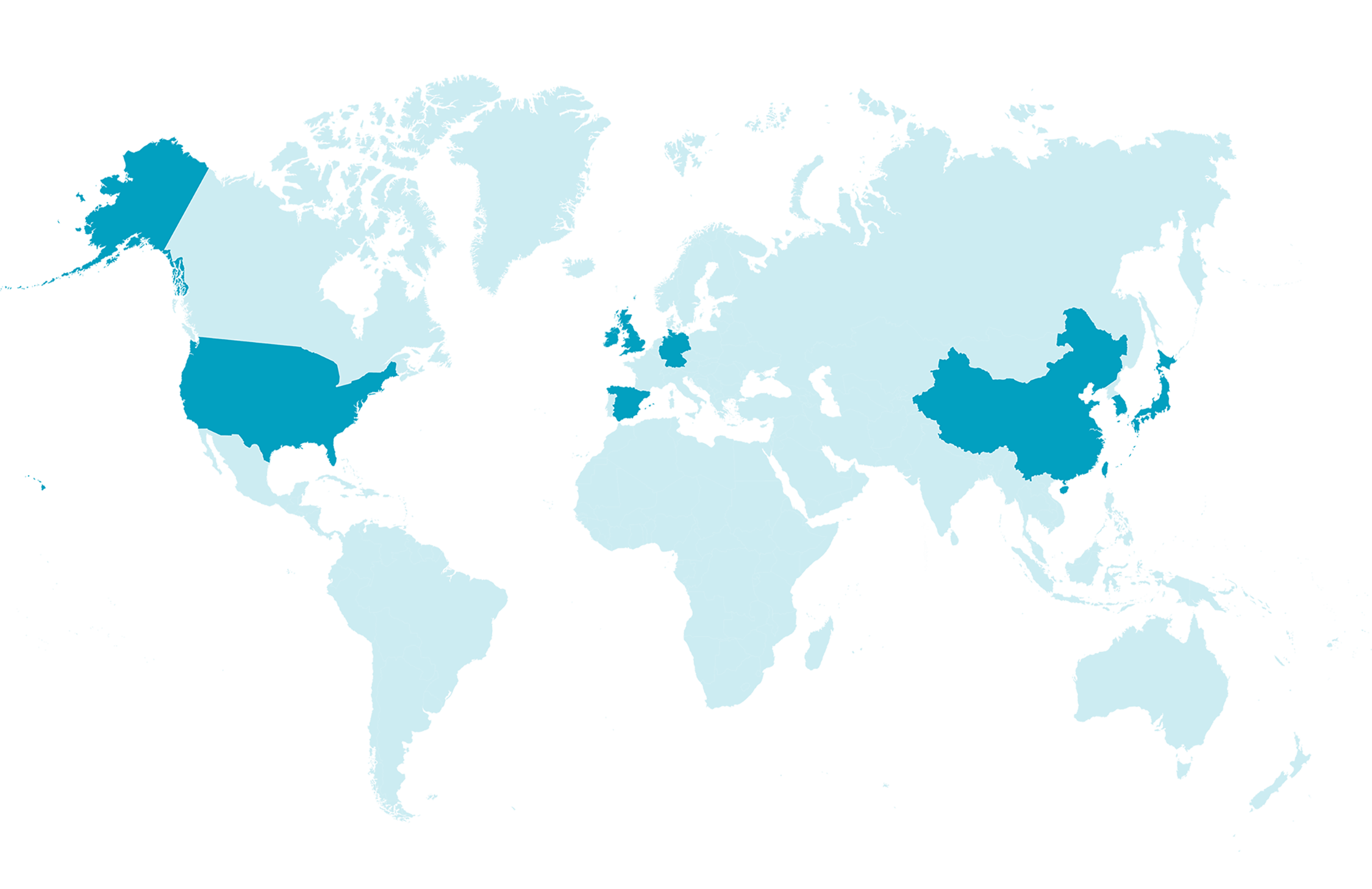
The Future of Refractive Surgery is a consumer survey sponsored by STAAR Surgical among 7,800 current glasses and/or contact lens wearers aged 21-65 in seven markets: the United States (n=1,800), the United Kingdom and Ireland, Germany, Spain, China, Japan and South Korea (n=1,000 each). Fieldwork ran from March 2025 to May 2026. The Asia-Pacific surveys were fielded in May 2026 (China, Japan, South Korea). Procedure-mix figures are from Market Scope.
Suggested citation: STAAR Surgical. The Future of Refractive Surgery: Asia-Pacific Findings. 2026. staar.com/future-of-refractive-surgery/asia-pacific
Published [Month 2026]
Last updated [date]
[MLR Project Number]