

FORS-New
Future of Refractive Surgery
A global report from STAAR Surgical highlights consumer sentiment in a structural shift across seven major markets, from laser to lens-based vision correction.
The Future of Refractive Surgery: A Global Consumer Survey from STAAR Surgical
STAAR Surgical’s Future of Refractive Surgery survey of 7,800 glasses and contact lens wearers in seven markets found that 80% want to be free of glasses and contact lenses, 58% would prefer a reversible procedure, and 59% are not open to laser.1 Unaided awareness of the implantable Collamer lens (ICL) ranges from 18.9% in Germany to 48.5% in China.
| 7,800 | 80% | 59% | 58% |
| glasses and contact lens wearers in seven markets | want to be free of glasses and contact lenses | are not open to laser1 | would prefer a reversible procedure |
1 Laser sentiment (Not Open/Open/Undecided) reflects share of options selected on “What do you think of Laser Vision Correction Surgery? Select all that apply.” Source: STAAR Consumer Survey, Global Combined Summary (n=7,800).
SEVEN MARKETS · 7,800 VOICES
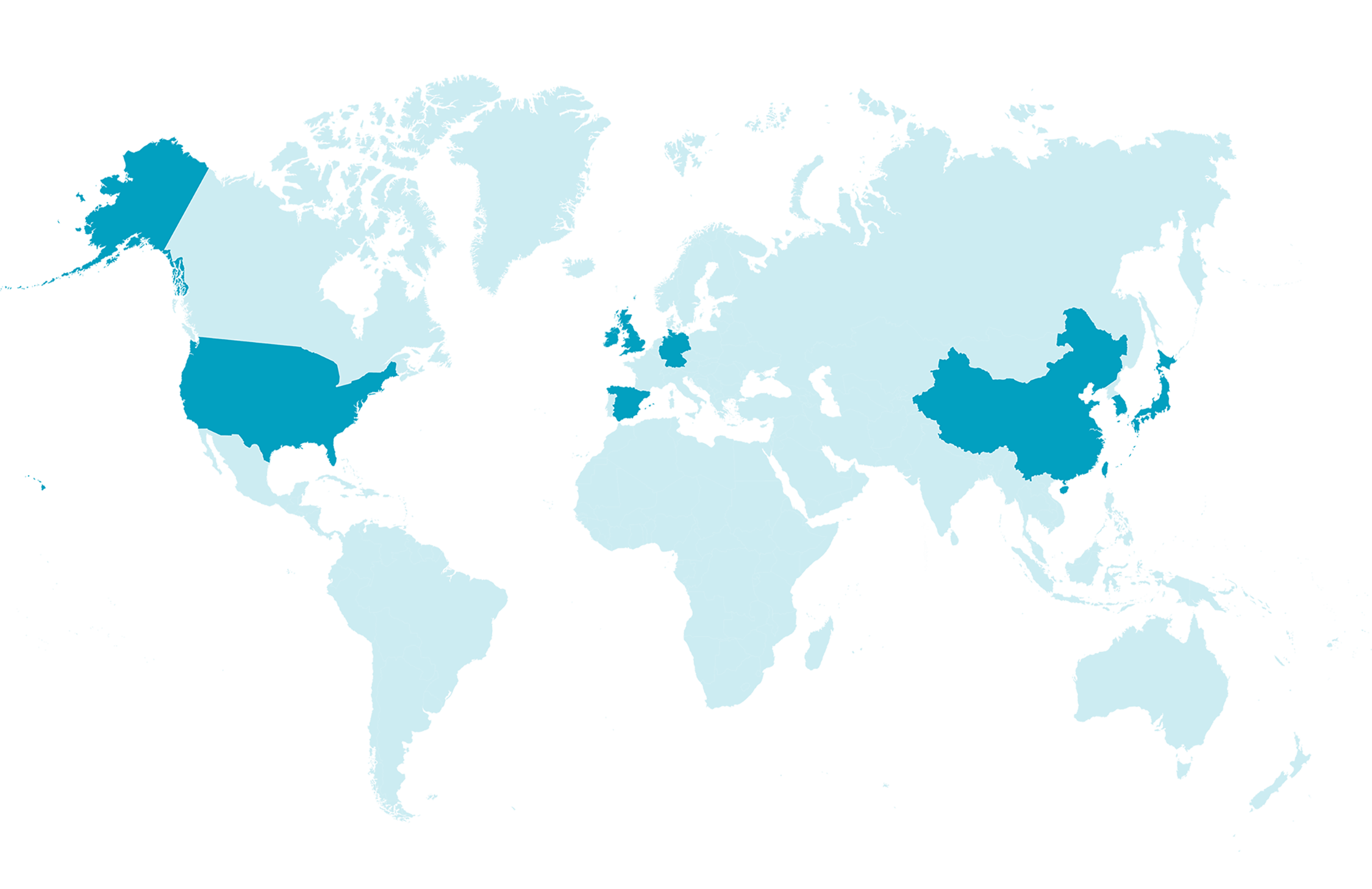
United States · UK and Ireland · Germany · Spain · China · Japan · South Korea
What did STAAR Surgical’s global survey find?
Key findings from STAAR Surgical’s survey of 7,800 glasses and contact lens wearers, fielded between March 2025 and May 2026:
- 80% of respondents want to be free of glasses and contact lenses.
- 59% are not open to laser, while 26% are open.1
- Top responses about laser vision correction included safety concerns (38%) and fear of the procedure (38%).
- 58% would prefer a reversible procedure.
- Unaided awareness of ICL ranges from 18.9% in Germany to 48.5% in China.
- Phakic IOLs grew from 3.4% of refractive procedures worldwide in 2015 to 15.4% in 2025 (Market Scope).
Sources: STAAR Consumer Survey, Global Combined Summary (n=7,800); Market Scope, 2025 Refractive Surgery Market Report.
1 Laser sentiment (Not Open/Open/Undecided) reflects share of options selected on “What do you think of Laser Vision Correction Surgery? Select all that apply.”
How do consumers feel about laser eye surgery?
Across seven markets, 59% are not open to laser, 15% are undecided and 26% are open.1 Top responses included safety concerns (38%), fear of the procedure (38%) and cost (32%).
The Majority Say No to Laser, Yes to a Reversible Option
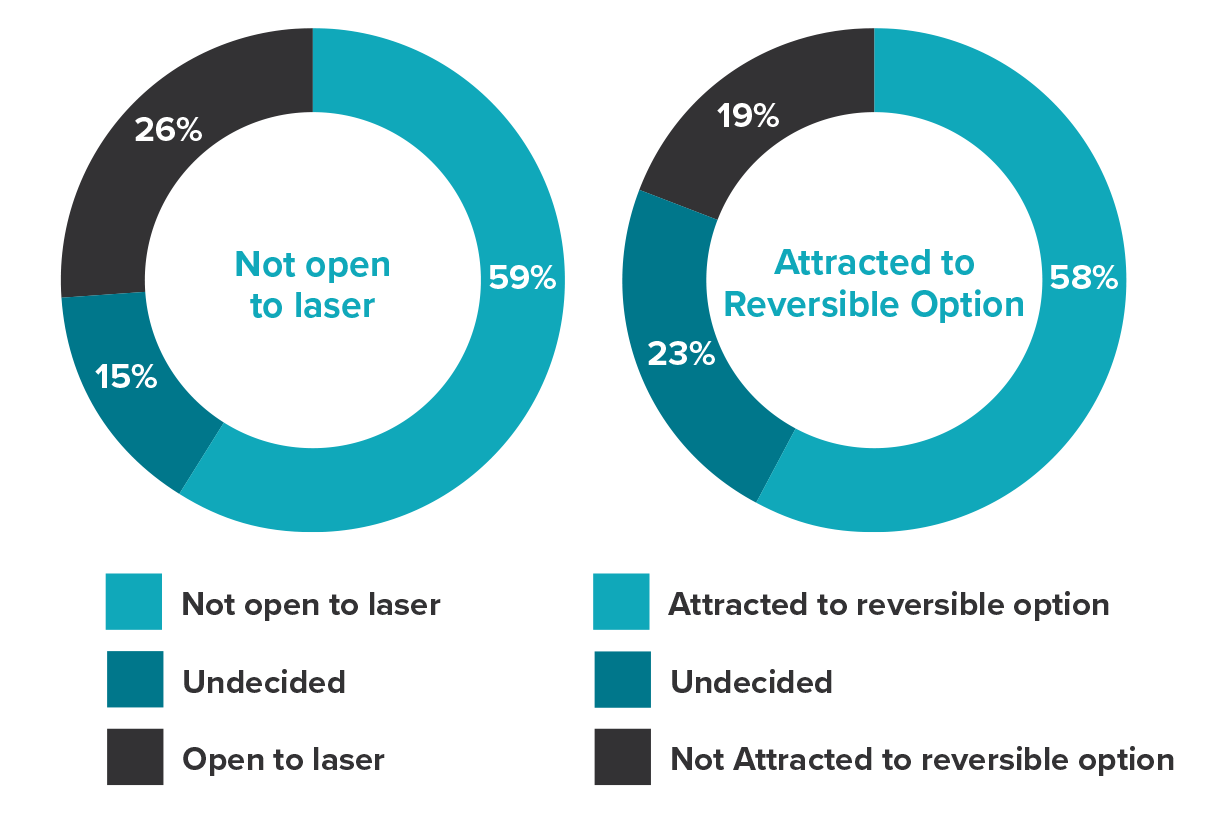
59% are not open to laser across seven markets, while 26% are open.
Table: The Majority Say No to Laser, Yes to a Reversible Option
| Chart | Segment | % |
| Not open to laser | Not open to laser | 59% |
| Not open to laser | Undecided | 15% |
| Not open to laser | Attracted to reversible option | 26% |
| Attracted to Reversible Option | Attracted to Reversible Option | 58% |
| Attracted to Reversible Option | Undecided | 23% |
| Attracted to Reversible Option | Not Attracted to reversible option | 19% |
1 Laser sentiment (Not Open/Open/Undecided) reflects share of options selected on “What do you think of Laser Vision Correction Surgery? Select all that apply.”
Source: STAAR Consumer Survey, all markets (n = 7,800). Reversible-option attraction reflects “Would you prefer a reversible procedure to give you peace of mind and future options?”
Do consumers want a reversible vision correction procedure?
Many do: 58% of the 7,800 glasses and contact lens wearers in STAAR Surgical’s survey said they would prefer a reversible procedure to give them peace of mind and future options.
Consumers Are Drawn to a Reversible Surgical Solution (% Attracted to a Reversible Procedure
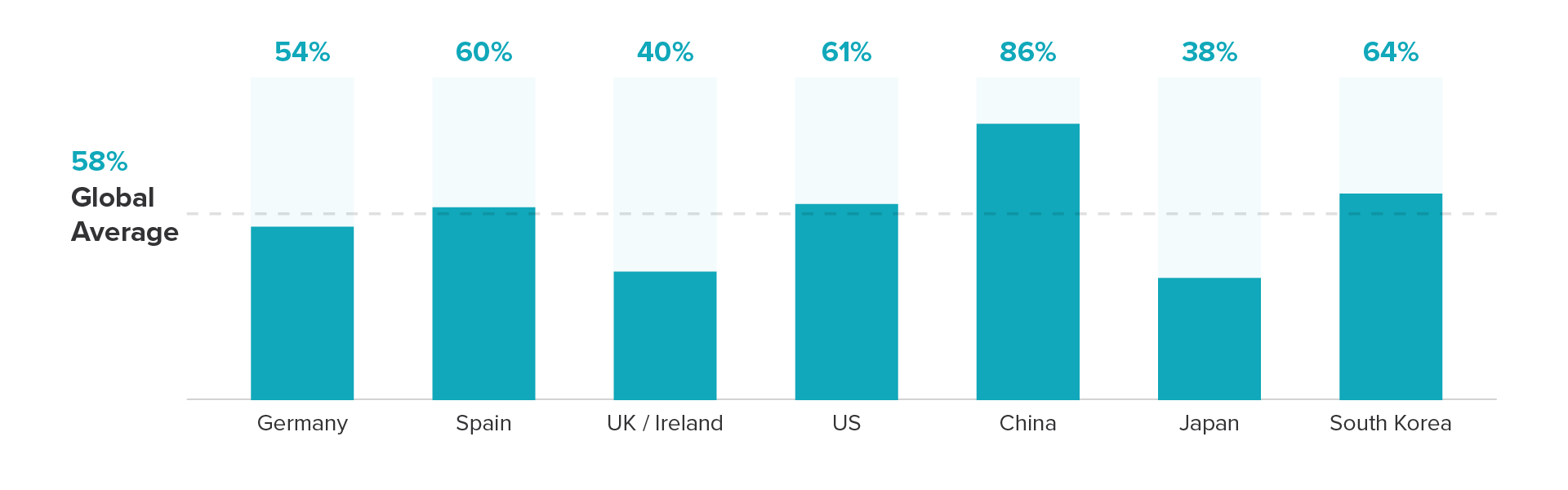
58% would prefer a reversible procedure.
Table: Consumers Are Drawn to a Reversible Surgical Solution (% Attracted to a Reversible Procedure)
| Market | % Attracted to a Reversible Procedure |
| Global Average | 58% |
| Germany | 54% |
| Spain | 60% |
| UK / Ireland | 40% |
| US | 61% |
| China | 86% |
| Japan | 38% |
| South Korea | 64% |
Source: STAAR Consumer Survey, Global Combined Summary (n=7,800).
How aware are consumers of ICL?
Unaided awareness of the implantable Collamer lens (ICL) is generally low compared to laser-based procedures, ranging from 18.9% in Germany to 48.5% in China. In the West, awareness is 18.9% in Germany, 19.3% in the US and 20% in the UK and Ireland, rising to 27% in Spain. In Japan, 46% of respondents are aware of ICL unaided.
Unaided ICL Awareness by Market
Which of the following vision correction procedures are you aware of? Select all that apply.
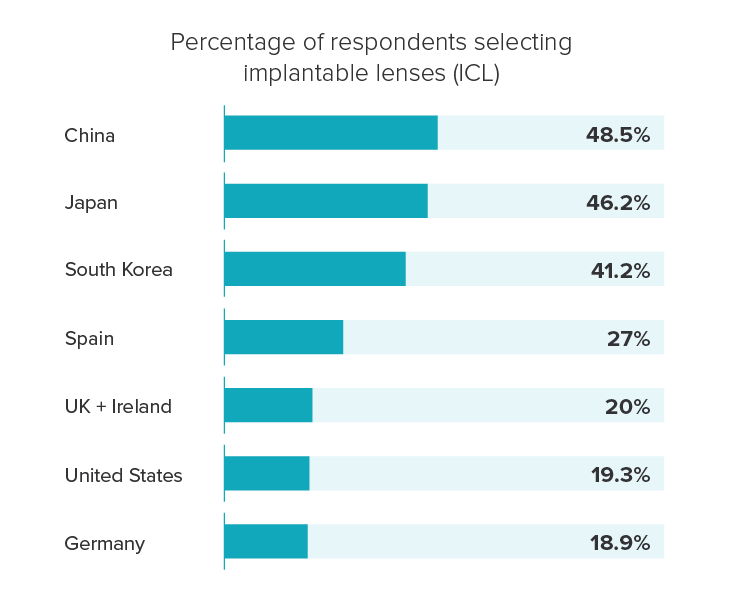
Unaided ICL awareness ranges from 18.9% in Germany to 48.5% in China.
Table: Unaided ICL Awareness by Market
| Market | Percentage of respondents selecting implantable lenses (ICL) |
| China | 48.5% |
| Japan | 46.2% |
| South Korea | 41.2% |
| Spain | 27% |
| UK + Ireland | 20% |
| United States | 19.3% |
| Germany | 18.9% |
Source: STAAR Consumer Survey. n=1,000 per market (US n=1,800). Fieldwork: UK + Ireland Mar 2025; US Aug 2025; Germany & Spain Mar 2026; China, Japan, South Korea May 2026.
What would make one procedure worth paying more for?
Asked which benefits would justify paying more for one procedure over another, respondents most often chose “no tissue removed, eye anatomy stays intact” (40%), “excellent night vision” (39%) and “less regression over time” (39%).
What Would Justify Paying More for Surgery: % Who Say This Would Justify A Higher Cost
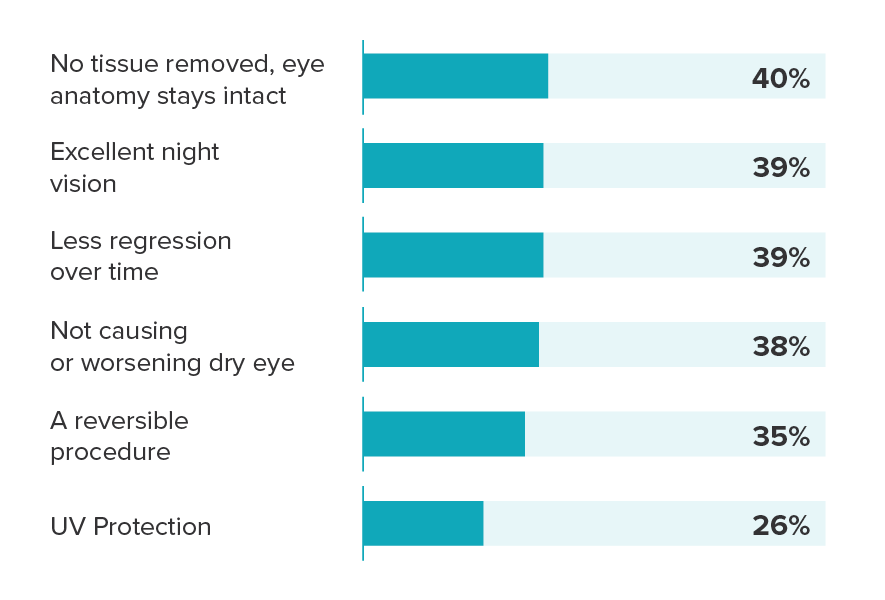
“No tissue removed” (40%) tops the benefits consumers say would justify a higher cost.
Table: What Would Justify Paying More for Surgery
| Benefit | % Who Say This Would Justify A Higher Cost |
| No tissue removed, eye anatomy stays intact | 40% |
| Excellent night vision | 39% |
| Less regression over time | 39% |
| Not causing or worsening dry eye | 38% |
| A reversible procedure | 35% |
| UV Protection | 26% |
Source: STAAR Consumer Survey, Global Combined Summary (n=7,800).
Frequently asked questions
Why are some consumers hesitant about laser eye surgery?
Safety and fear come up most often. In STAAR Surgical’s survey of 7,800 glasses and contact lens wearers in seven markets, top responses about laser vision correction included safety concerns (38%) and fear of the procedure (38%), and 59% are not open to laser.1 What holds people back differs by market: cost leads in Germany (67%) and Spain (72%), while concerns about safety or potential complications lead in China (76%) and the UK and Ireland (74%). In the US, where respondents chose the one factor holding them back most, cost was the top single answer (37%), but more than half named a non-cost concern, led by safety concerns (27%) and fears (21%).
Are consumers interested in alternatives to laser eye surgery?
Yes. Of those asked, a majority said they would be interested in an alternative to laser that gets them out of glasses and contact lenses.
Why does reversibility matter to consumers considering vision correction?
It offers peace of mind and keeps future options open. Asked whether they would prefer a reversible procedure for those reasons, 58% of the 7,800 respondents in STAAR Surgical’s survey said yes. 35% also said a reversible procedure would justify paying more for one procedure over another.
What matters most to consumers when choosing a vision correction procedure?
Asked which benefits would justify paying more, respondents most often chose “no tissue removed, eye anatomy stays intact” (40%), “excellent night vision” (39%), “less regression over time” (39%) and “not causing or worsening dry eye” (38%).
Where do consumers look for information about vision correction procedures?
Eye care professionals remain the most-cited source of information in every market where the question was asked. But consumers are also turning to a broader mix of sources before and alongside their consultations, including search engines, AI tools such as ChatGPT, social media platforms such as YouTube and TikTok, online communities, and friends and family.
Who took part in STAAR Surgical’s Future of Refractive Surgery survey?
7,800 current glasses and/or contact lens wearers aged 21-65 in seven markets: the United States (1,800 respondents), and the UK and Ireland, Germany, Spain, China, Japan and South Korea (1,000 each). Fieldwork ran from March 2025 to May 2026.
1 Laser sentiment (Not Open/Open/Undecided) reflects share of options selected on “What do you think of Laser Vision Correction Surgery? Select all that apply.”
Explore the findings by region and country








About the research
The Future of Refractive Surgery is a consumer survey sponsored by STAAR Surgical among 7,800 current glasses and/or contact lens wearers aged 21-65 in seven markets: the United States (n=1,800), the United Kingdom and Ireland, Germany, Spain, China, Japan and South Korea (n=1,000 each). Fieldwork ran from March 2025 to May 2026. Procedure-mix figures are from Market Scope.
Suggested citation: STAAR Surgical. The Future of Refractive Surgery: A Global Report from STAAR Surgical. 2026. staar.com/future-of-refractive-surgery
Published [Month 2026]
Last updated [date]
[MLR Project Number]